New evidence details Japanese army's biochemical warfare
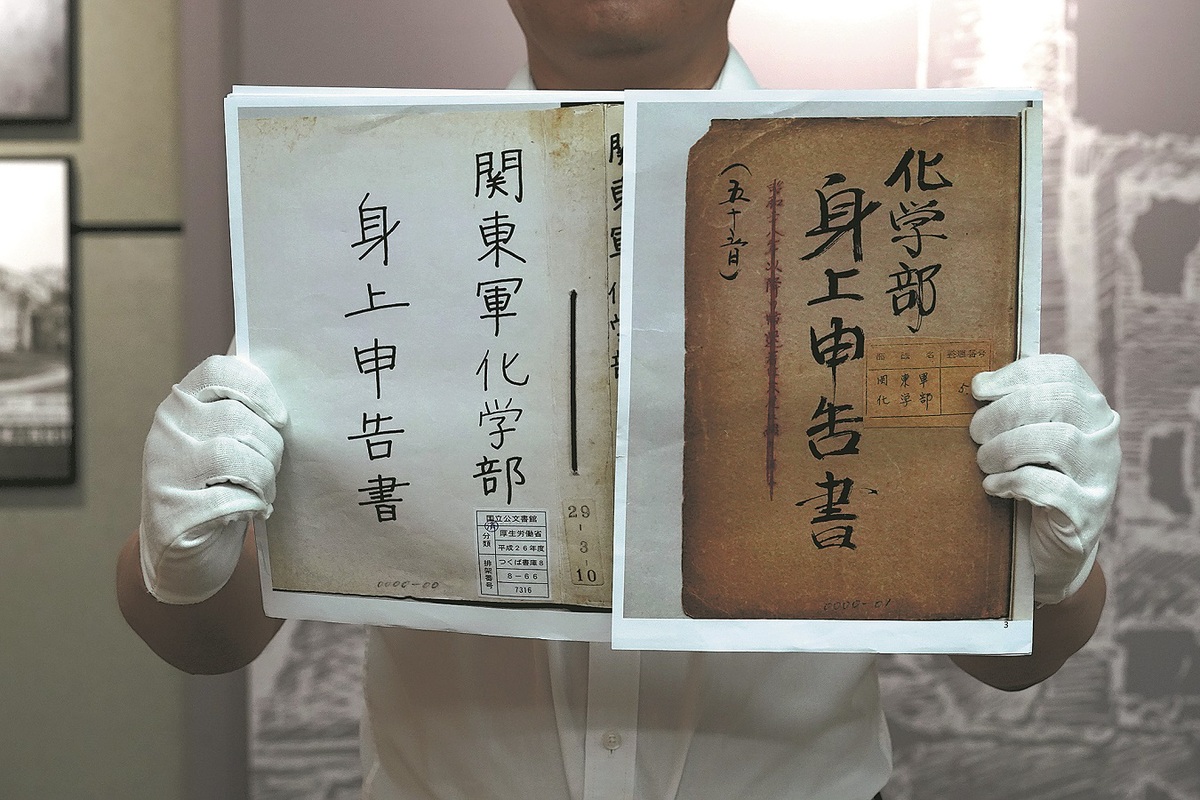
The Exhibition Hall of Evidences of Crime Committed by Unit 731 of the Japanese Imperial Army in Harbin, Heilongjiang province, has released newly examined evidence documenting atrocities committed during the Chinese People's War of Resistance Against Japanese Aggression (1931-45).
The evidence consists of registration files for the Imperial Japanese Army's Kwantung Army Chemical Department.
Established in 1939 in Qiqihar, Heilongjiang province, the department, also known as Unit 516, was primarily responsible for the Japanese army's research and use of chemical weapons in China.
Dedicated to the development of nerve, blister, choking and irritant agents, it was one of Japan's core chemical warfare units.
The newly released document is a standardized record completed by former members of Unit 516 upon their return to Japan after the war, making it an important official military record.
The document was transferred to the National Archives of Japan in 2000 and was gradually declassified.
During an evidence collection trip to Japan in 2023, researchers from the museum obtained the document after extensive searches, communication and negotiations. Following systematic collation and research, its contents have now been made public.
The document contains 148 pages covering information on 108 individuals, including military-affiliated appointed civil officials, military-affiliated employees, army technical warrant officers, military-affiliated servants, army medical lieutenants, veterinary corporals, artillerymen and chemical technicians.
"It is a standardized document used by the Japanese government to record the demobilization of Japanese soldiers after the war," said Jin Shicheng, director of the museum's education and publicity department.
"It includes information such as names, places of origin, family information, military branches, landing times and locations, ranks, prewar units, times and places of disarmament, and postwar experiences."
"The initial establishment of Unit 516 involved 250 personnel," Jin said. "Following the discovery and publication of a personnel roster of Unit 516 in 2022, it was confirmed that the unit had 414 members."
"The newly released document records 108 individuals. After systematic sorting and verification, 17 duplicate records were identified, bringing the known number of personnel in Unit 516 to 505," he said.
"Due to frequent transfers, secondments and temporary assignments during the war, the figure does not represent the total number of individuals who served in Unit 516," Jin added. "Further historical materials are needed to complete the record."
Previous research, based on confessions by convicted Japanese war criminals, confirmed that Unit 516 collaborated with Unit 731 and Unit 100 to carry out poison gas experiments.
"In the newly released document, information on former member Hiroshi Kusunoki clearly shows his participation in veterinary training at the education department of Unit 100 while serving with Unit 516, further demonstrating the close cooperation between Unit 516 and Unit 100," Jin said.
"Combined with previous research, the records confirm that Units 731, 516 and 100 formed a biochemical warfare system covering humans, animals and the environment through personnel exchanges and technology sharing."
Jin said the document provides crucial evidence for a more comprehensive understanding of the scale, organizational structure, coordinated crimes, personnel transfers and postwar trajectories of Unit 516.
"It further confirms that Japan's wartime chemical warfare crimes were large-scale, organized crimes carried out through a top-down system," he said.
Web editors: Shen Jianqi, Zhang Rui