Traditional enterprises leading the way with advanced manufacturing
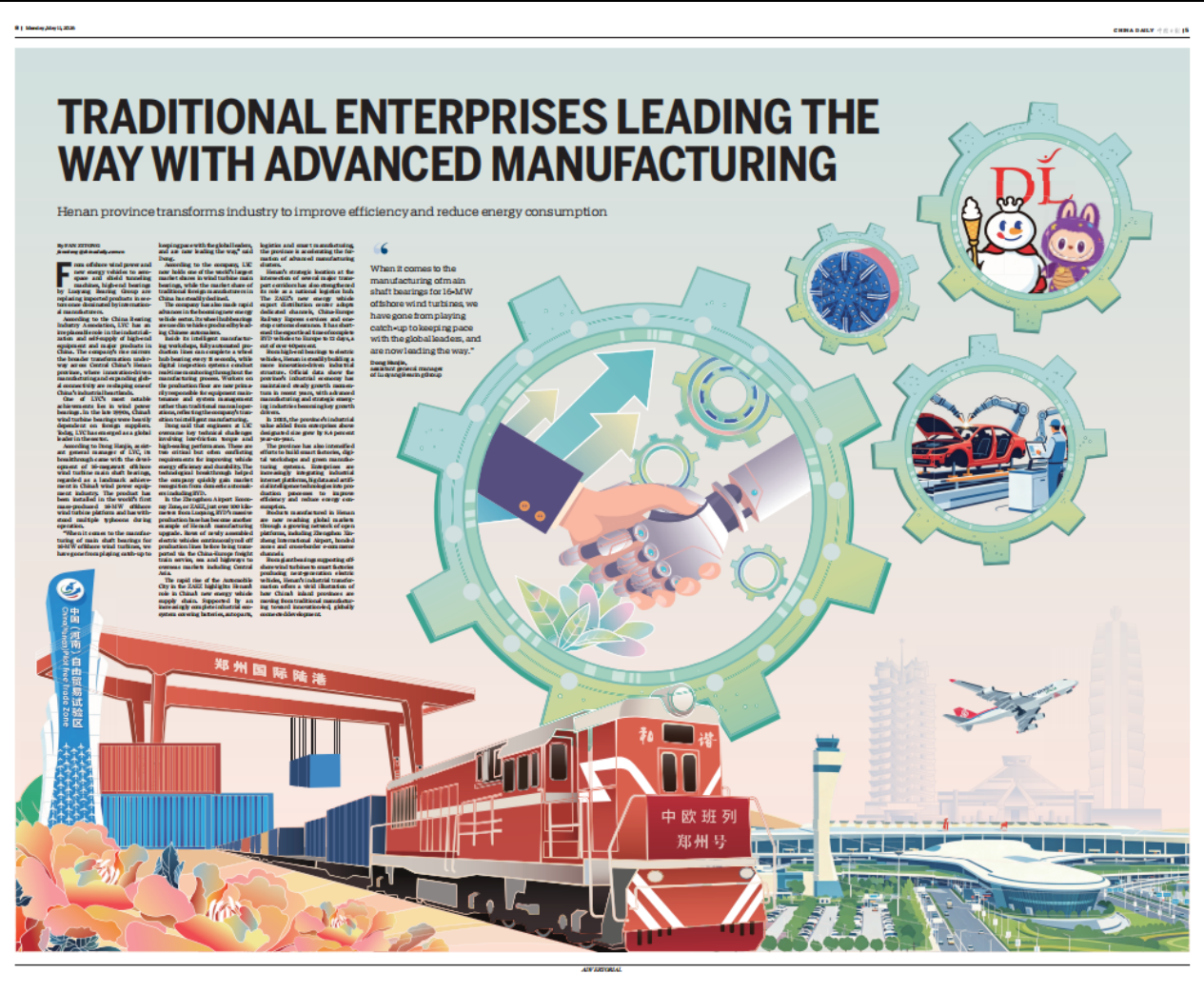
From offshore wind power and new energy vehicles to aerospace and shield tunneling machines, high-end bearings by Luoyang Bearing Group are replacing imported products in sectors once dominated by international manufacturers.
According to the China Bearing Industry Association, LYC has an irreplaceable role in the industrialization and self-supply of high-end equipment and major products in China. The company's rise mirrors the broader transformation underway across Central China's Henan province, where innovation-driven manufacturing and expanding global connectivity are reshaping one of China's industrial heartlands.
One of LYC's most notable achievements lies in wind power bearings. In the late 1990s, China's wind turbine bearings were heavily dependent on foreign suppliers. Today, LYC has emerged as a global leader in the sector.
According to Dong Hanjie, assistant general manager of LYC, its breakthrough came with the development of 16-megawatt offshore wind turbine main shaft bearings, regarded as a landmark achievement in China's wind power equipment industry. The product has been installed in the world's first mass-produced 16-MW offshore wind turbine platform and has withstood multiple typhoons during operation.
"When it comes to the manufacturing of main shaft bearings for 16-MW offshore wind turbines, we have gone from playing catch-up to keeping pace with the global leaders, and are now leading the way," said Dong.
According to the company, LYC now holds one of the world’s largest market shares in wind turbine main bearings, while the market share of traditional foreign manufacturers in China has steadily declined.
The company has also made rapid advances in the booming new energy vehicle sector. Its wheel hub bearings are used in vehicles produced by leading Chinese automakers.
Inside its intelligent manufacturing workshops, fully automated production lines can complete a wheel hub bearing every 15 seconds, while digital inspection systems conduct real-time monitoring throughout the manufacturing process. Workers on the production floor are now primarily responsible for equipment maintenance and system management rather than traditional manual operations, reflecting the company's transition to intelligent manufacturing.
Dong said that engineers at LYC overcame key technical challenges involving low-friction torque and high-sealing performance. These are two critical but often conflicting requirements for improving vehicle energy efficiency and durability. The technological breakthrough helped the company quickly gain market recognition from domestic automakers including BYD.
In the Zhengzhou Airport Economy Zone, or ZAEZ, just over 100 kilometers from Luoyang, BYD's massive production base has become another example of Henan's manufacturing upgrade. Rows of newly assembled electric vehicles continuously roll off production lines before being transported via the China-Europe freight train service, sea and highways to overseas markets including Central Asia.
The rapid rise of the Automobile City in the ZAEZ highlights Henan's role in China's new energy vehicle supply chain. Supported by an increasingly complete industrial ecosystem covering batteries, auto parts, logistics and smart manufacturing, the province is accelerating the formation of advanced manufacturing clusters.
Henan's strategic location at the intersection of several major transport corridors has also strengthened its role as a national logistics hub. The ZAEZ's new energy vehicle export distribution center adopts dedicated channels, China-Europe Railway Express services and onestop customs clearance. It has shortened the export lead time of complete BYD vehicles to Europe to 12 days, a cut of over 40 percent.
From high-end bearings to electric vehicles, Henan is steadily building a more innovation-driven industrial structure. Official data show the province's industrial economy has maintained steady growth momentum in recent years, with advanced manufacturing and strategic emerging industries becoming key growth drivers.
In 2025, the province's industrial value added from enterprises above designated size grew by 8.4 percent year-on-year.
The province has also intensified efforts to build smart factories, digital workshops and green manufacturing systems. Enterprises are increasingly integrating industrial internet platforms, big data and artificial intelligence technologies into production processes to improve efficiency and reduce energy consumption.
Products manufactured in Henan are now reaching global markets through a growing network of open platforms, including Zhengzhou Xinzheng International Airport, bonded zones and cross-border e-commerce channels.
From giant bearings supporting offshore wind turbines to smart factories producing next-generation electric vehicles, Henan's industrial transformation offers a vivid illustration of how China's inland provinces are moving from traditional manufacturing toward innovation-led, globally connected development.
Web editors: Shen Jianqi, Tong Lin